Design mockup. Cutbank Granite Works is an invented business. The name, address, telephone number and hours on this page are placeholders and reach nobody.

Cutbank Granite Works Letter cutting and setting · Cameron, Missouri · since 1872
(816) 555-0148
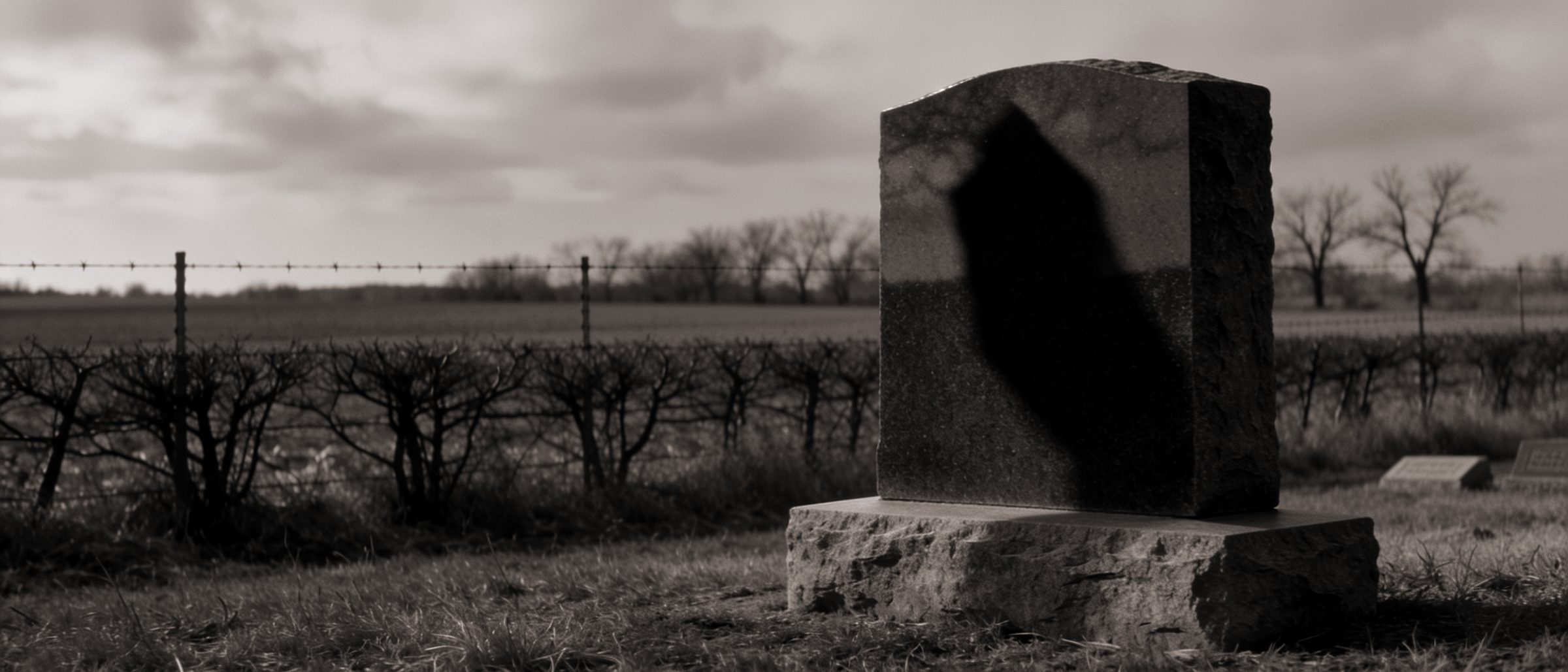
A dark polished granite die with a rock-pitched top standing on a rough-hewn granite base in a flat winter cemetery, its front face blank and in shadow, a barbed wire fence and bare hedgerow running behind it to open farmland.

Granite, cut and set · est. 1872

Most of a monument
is underground.

Four to six inches of granite you can see, and thirty inches of concrete you cannot. This page runs the whole of it in the order it is measured, from the paint in the letter down to the rock it was cut from.

Call the shop · (816) 555-0148 What your cemetery allows comes first

Before anything is chosen

The first call we make is not to a quarry.

Two cemeteries three miles apart can permit completely different objects, and neither of them will tell you until somebody asks. So we ask first, in writing, before you look at a single piece of stone. It saves a family choosing something that was never going to be allowed to stand there.

There are three answers we get back, and they decide the shape of everything after.

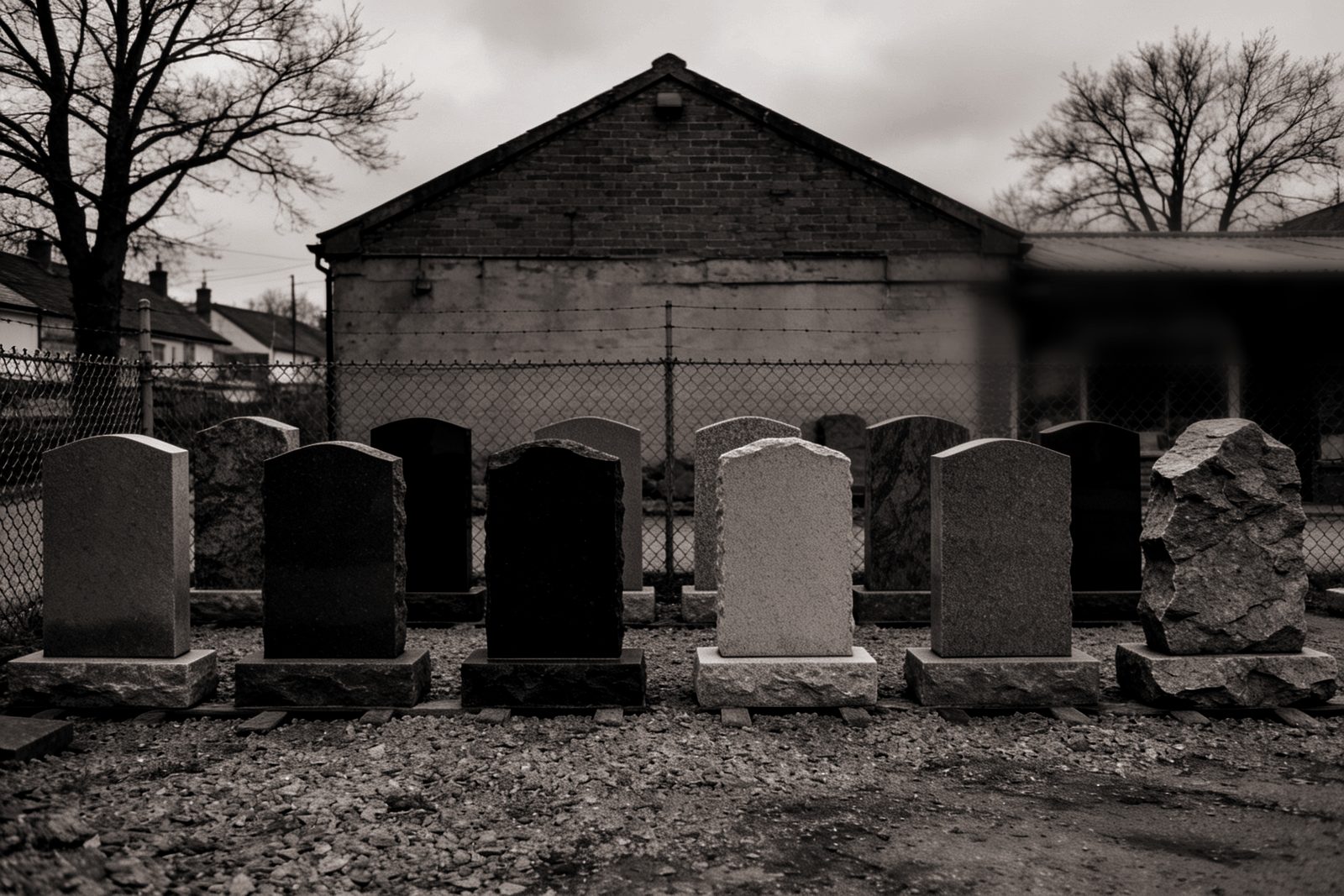
A row of finished granite memorials of different colours and finishes standing on gravel in an outdoor display yard, every face blank, a chain link fence and the brick gable of an old works building behind them.
The yard. Grey, mahogany, black, pink and a rock-pitched boulder, all standing outside in the same light your cemetery gets.
Bronze on granite, flush
Garden and memorial-park sections. The marker is cast bronze mounted on a granite ledger and set level with the turf so the mowers never lift a blade. An upright is not an option here, and that is settled before you have chosen a colour, a letter style or a size.
Granite only, flush
Under the City of Cameron's cemetery ordinance, a marker in Graceland Memorial must be granite or an approved government marker for a veteran, set flush with the ground for unrestricted mowing, and not less than four inches thick with a flat-sawed bottom.
Uprights permitted
Older sections and most church grounds. Height and width are still governed, the base is normally required to run longer than the die it carries, and vases are often refused outright because of what happens to them.

All foundations for markers in the City cemeteries shall be prepared with a minimum of 30 inches of concrete. No marker may be set until the foundation has been approved by the City.

Drawn to scale, in section

One stone, cut through the middle.

Everything below is measured against the same two datums a foundation crew uses: the finished grade, and the face of the stone. The letter cut is drawn separately because at this scale it would be thinner than the line around it.

Section through a set upright monument, drawn at fourteen pixels to the inch. The letter profile at the lower right is magnified forty times.

A vertical cross-section. A twenty-four inch granite die stands on a six inch granite base, joined by a bead of setting compound three eighths to one half of an inch thick. The base sits on a concrete foundation that extends thirty inches below finished grade into undisturbed clay and is poured wider than the base on every side. A depth scale on the left runs from thirty inches above grade down to thirty inches below it. A magnified detail shows three letter profiles: a skin cut one thirty-second to one sixteenth of an inch deep, a square-raised letter with the surrounding ground cut down an eighth of an inch, and a V-sunk groove deepened by hand.

0.00 inches · the paint

The paint is not the memorial.

Lithichrome is the trade's stone lettering paint and it does its job well, but it is a refreshable enhancement sitting on top of the record. The record is the cut underneath. We cut deep enough that a name reads on a grey afternoon with nothing in the groove at all, because that is the version of the stone that has to work in eighty years.

When the paint dulls, it is a small job. You do not have to come to us for it and we will tell you plainly what it costs before you ask.

1/32 to 1/16 in · the skin cut

The shallowest thing we cut, and only on black.

A skin-traced letter is blasted a thirty-second to a sixteenth of an inch into the face. On black granite that is enough, because the contrast comes from the removed polish rather than from the depth. Put the same cut on a speckled grey and it disappears into the grain from ten feet away.

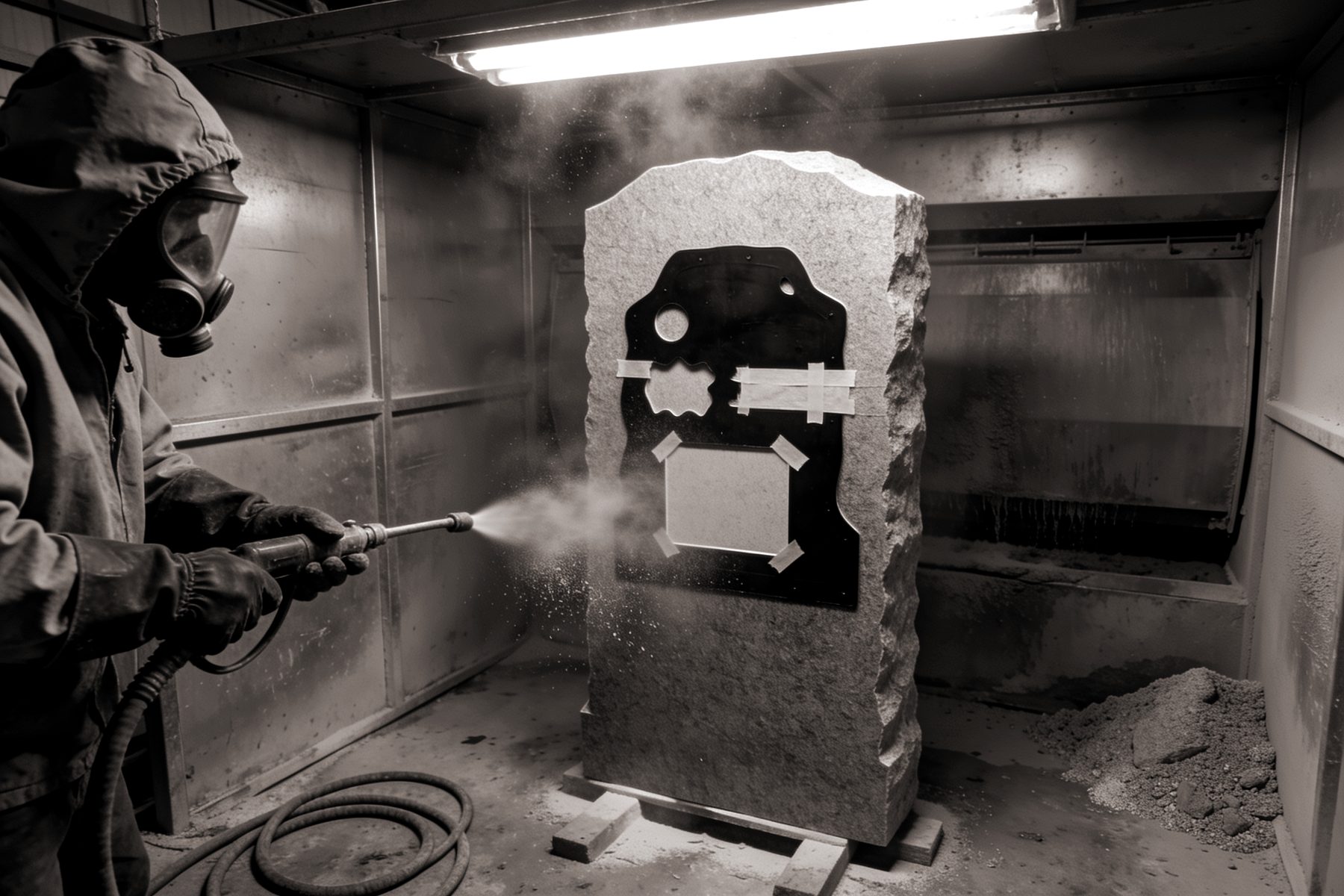
A worker in a canvas hood and full-face respirator directing a blasting nozzle at a grey granite die standing in a steel blast cabinet, a black rubber stencil taped across its face and abrasive dust drifting under the strip light.
The booth. Compressed air drives aluminium oxide grit through the openings in a rubber stencil, and the number of passes decides how deep the letter goes.
0 the polish itself · laser etching

A laser etching is made out of missing polish.

The beam takes the polished layer off in dots and exposes the lighter unpolished stone underneath. Grey values come from how densely those dots are placed, the way a printer works, except that nothing is being put on. It is not paint. It will not wash off, and rain does not touch it.

What is true and gets left out: the etching lives in the polished surface and it is shallower than a blasted letter, so it lasts exactly as long as that polish does. Colour added to an etching is a different matter. Colour fades, it is sealed rather than cut, and it is refreshable in the same way paint is.

Why it is only ever done on black. The whole picture is light dots against dark polish. Any natural colour variation in the stone competes with the image and eats it. The trade uses Absolute Black from India and Shanxi Black from China for this and almost nothing else, chosen for a dense even grain with no white veining running through it.

1/8 inch · square-raised

Cut the ground away and leave the letter standing.

The field around the lettering is blasted down about an eighth of an inch and the letter faces are then chiselled smooth, so they stand at the original polish while everything around them is textured. On dark stone this reads further down a row than anything else we can do, and it needs no paint to do it.

It is slower than a sunk letter and it costs more. On a small marker with four lines on it, it is usually not worth the difference. On a family stone that carries a surname across the top, it usually is.

V sunk, then deepened by hand

On light stone the shadow does the work.

Barre grey, Bethel white and the pale stones generally cannot supply contrast out of their own colour, so the groove has to. We blast it, then cut it deeper by hand to a true V, and the two faces of that V catch light and shade against each other. That shadow is what you are reading at forty feet, not the paint.

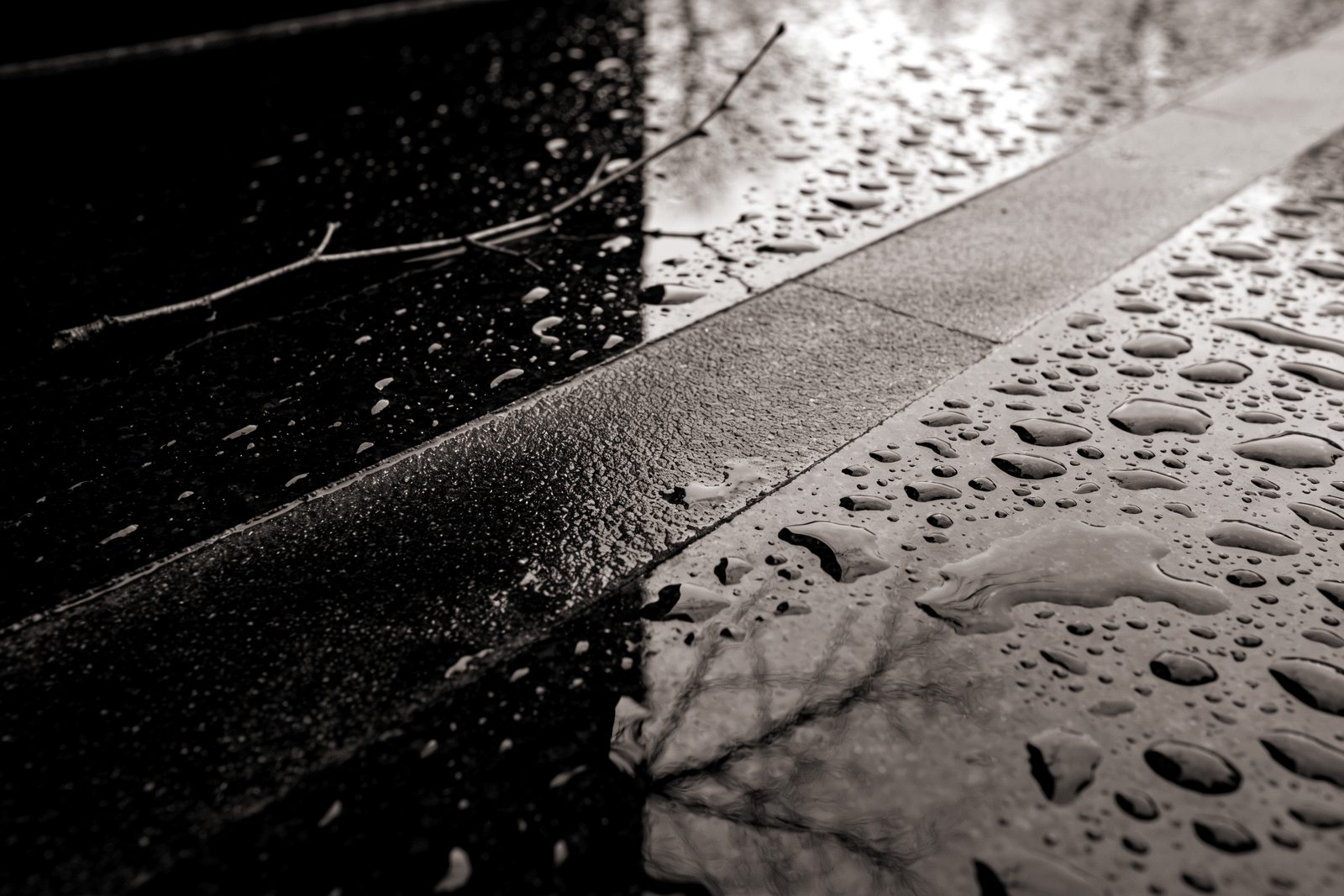
Ask to see the stone wet.

A frosted panel behind lettering looks crisp and pale under a showroom light. In rain the frosting darkens and can close right up against the granite around it, and the name gets harder to read on exactly the days people come out. There is a spray bottle on the bench for this. Ask us to use it before you decide anything, and look at the stone soaked rather than dry.

Close view of wet polished black granite beaded with rain, a matte sandblasted band running diagonally across it that has soaked dark until it barely separates from the polish on either side, a fallen twig and the reflection of bare branches lying on the surface.
Two weathered hands working a small rubber block across freshly sandblasted letter strokes cut into a dark polished granite marker, pale granite dust still lying in the grooves.
The letters go in through openings cut in a rubber stencil. The pale grit lying in the strokes is the stone that used to be there.
4–6 inches · the die

Six inches of granite is five hundred pounds.

Granite runs roughly 165 to 175 pounds per cubic foot. The National Park Service, which does this arithmetic for its own stonework, calculates dry and says to add ten to twenty per cent for a stone that has seen recent rain. So the numbers below are the light version.

Common die sizes, worked at 170 pounds per cubic foot
Die, width × thickness × heightVolumeWeight, dry
24 × 4 × 18 in1.00 cu ftabout 170 lb
30 × 6 × 20 in2.08 cu ftabout 354 lb
36 × 6 × 24 in3.00 cu ftabout 510 lb
48 × 8 × 24 in5.33 cu ftabout 907 lb

That is the whole reason a monument arrives on a truck with a hoist and two people, and the reason nobody quietly shifts one eighteen inches to the left later on because a flower bed went in.

6 inches · the base and its wash

The bevel on the base has one job, and it is drainage.

The wash is the bevelled top edge of the base. Water landing on the base runs off it rather than standing in the joint where the die meets it, which is the one place on a monument where standing water does long-term harm. It is not an ornament, and it is why a base is not a flat slab.

The base also lifts the die out of the mowing line and spreads its weight across the foundation. Most cemeteries that allow uprights require it to run longer than the die it carries, for exactly that reason.

3/8 to 1/2 in · the setting joint

It is supposed to stay soft.

The die is bedded onto the base on a continuous bead of monument setting compound, three eighths to half an inch thick, with lead wedges at the corners so the bead is not crushed flat and the stone comes up level. The visible outside edge skins over and hardens within a couple of weeks.

Under the surface it stays pliable for years, deliberately. That is the difference between this and mortar. A stone bedded this way can be lifted and reset thirty years from now, for a second inscription or after a lot is re-graded, without breaking either piece. If you press the joint on an older stone of ours and it gives slightly, nothing is wrong with it.

30 inches · the foundation

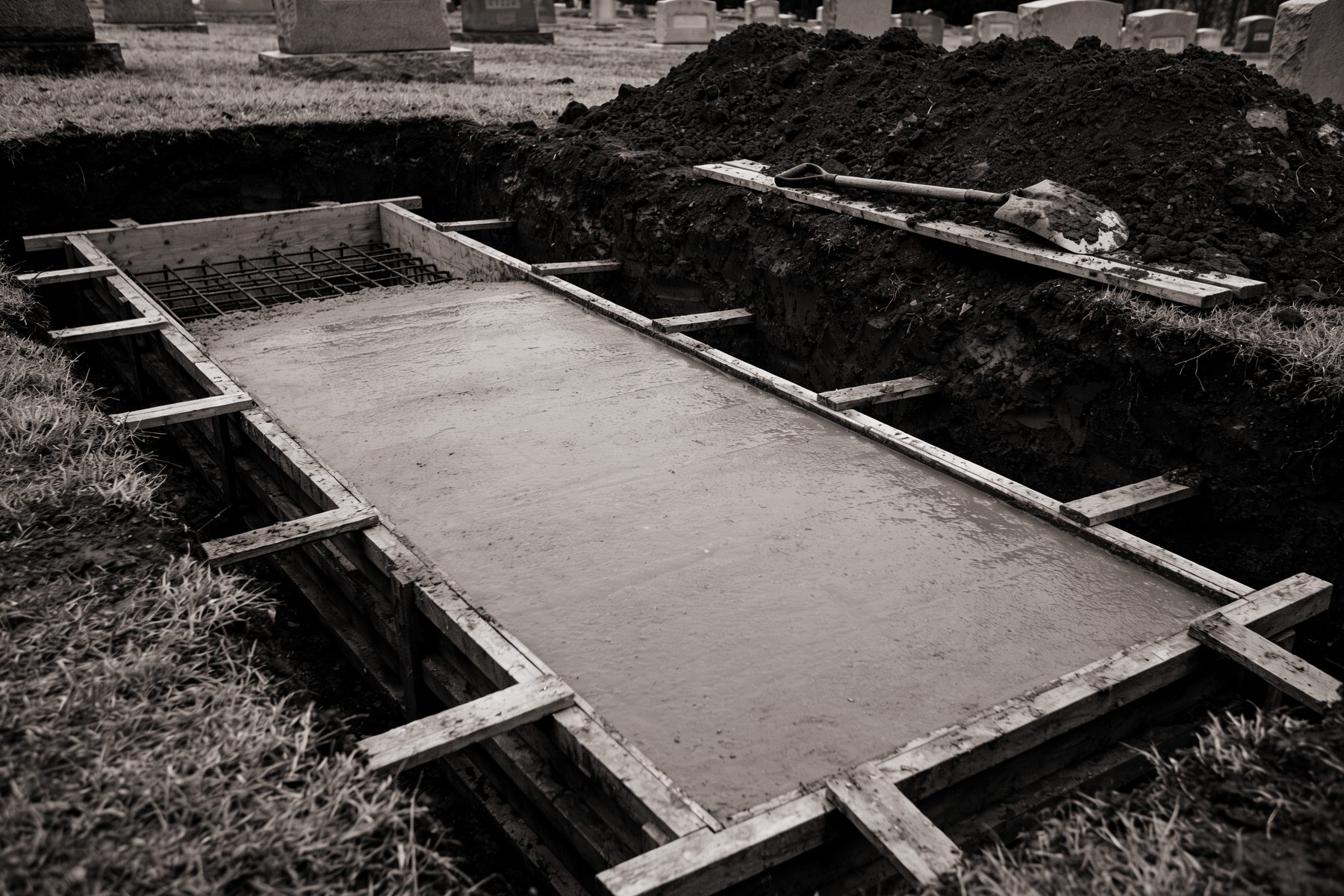
This part is inspected before we are allowed to set anything.

In the City cemeteries here the minimum is thirty inches of concrete and the City has to approve it before a marker goes on. That is not a formality we can work around, and a stone set on an unapproved foundation can be required to come back out.

It is poured on gravel, wider than the base on every side, and deep enough that a hard freeze lifts the ground around it rather than the footing itself. The form comes off after about seventy-two hours. The stone does not go on for roughly another week after that, while the pour finishes curing.

A rectangular pit cut into heavy brown clay in a cemetery, filled level with fresh grey concrete inside rough timber forms with reinforcing mesh showing at one end, a shovel laid across the spoil pile behind it.
the grave itself

We wait, and this is the part nobody likes.

After a burial the ground is full of air. Rain, gravity and one complete freeze and thaw are what close it. In this part of Missouri that means the better part of a year before an upright should stand on it. A stone set too early goes out of level, and then it has to be lifted, the foundation corrected, and the stone reset, which is worse for everyone than waiting was.

Flat markers can usually go sooner because a small settle does not show on them. If the grave was lined in concrete the wait can be short. We will tell you which of those you are in.

And the part that is not technical at all: there is no rule you have broken by having no stone yet. Nobody walking through that cemetery thinks a bare grave has been forgotten. It means a stone is being made, and that has always taken months.

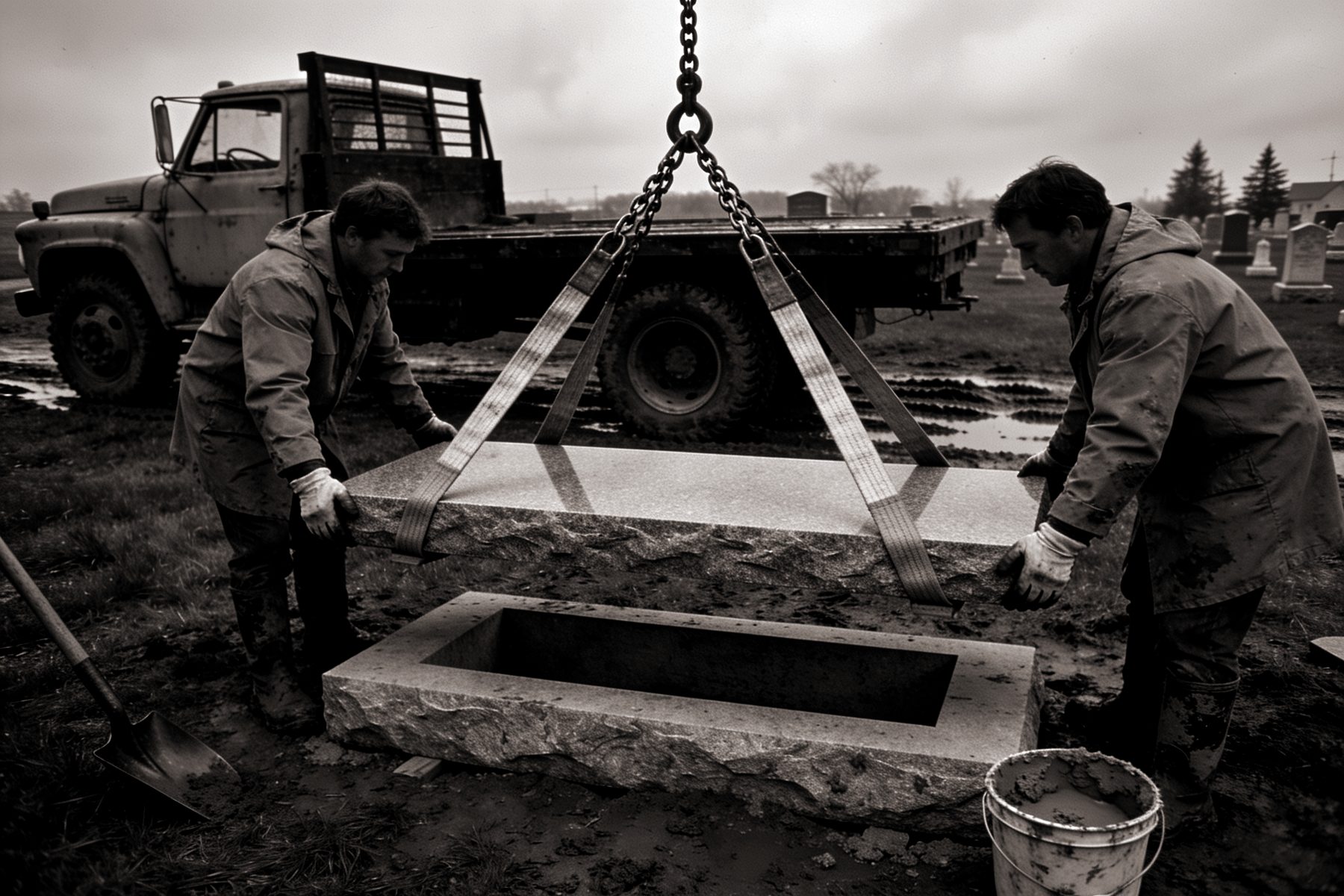
Two workers in wet-weather coats and muddy boots guiding a slab of granite down onto a rectangular granite curbing on chain-hoisted nylon straps, an old flatbed truck standing in the churned mud behind them.
Setting runs March to November here, weather allowing. Frozen or saturated ground is the one thing that will move a date we have given you.
380 million years · the stone

Everything above this line is our work. This part is not.

The Barre district in Vermont, which the Vermont Geological Survey reckons supplies about a third of the monuments made in this country, is a granodiorite pluton roughly four miles long, one mile wide and ten miles deep, dated between 380 and 330 million years old. The consistency of that one body of rock is the reason grey Barre became the trade's reference stone rather than anything about the marketing.

The Elberton deposit in Georgia formed about 325 million years ago and tested at an average of 23,450 psi in compression across ten samples from seven quarries. Around ninety per cent of what comes out of it becomes cemetery memorials. Missouri's own granite at Graniteville, the state rock, is between 1.4 billion and 1.1 billion years old and went into the footings of the Eads Bridge.

What the trade quotes against itself. The United States Bureau of Mines held that while a great many trade names are applied to memorial stones, it had no data indicating that any one of them is more enduring than any other. Within the colours your cemetery permits, choose the one you want to look at. That is a better reason than any of the others.
Three things worth knowing before you sign anything

None of this is on the paperwork you were handed.

  1. You are not required to buy the marker where you bought the grave.

    In a case that came up out of this state, the Eighth Circuit held that requiring lot purchasers to also buy the cemetery's own memorial foundation service was an illegal tying arrangement under the Sherman Act. A cemetery may charge a fee based on its actual labour cost to inspect finished third-party work, and it may impose reasonable requirements about scheduling, insurance and quality. It may not simply shut an outside dealer out.

    Rosebrough Monument Co. v. Memorial Park Cemetery Association, 736 F.2d 441 (8th Cir. 1984)

  2. Missouri caps what a cemetery may charge to let it be set.

    An endowed care cemetery may require a contribution to its care fund for each memorial installed, and by statute that contribution may not exceed twenty cents per square inch of base area. The same section requires it to be charged on every installation regardless of who performs the work, which is what stops it being used as a penalty on outside dealers.

    Section 214.335.1, Revised Statutes of Missouri

  3. Veterans Affairs supplies the marker and does not pay to set it.

    For an eligible veteran the headstone, marker or medallion is furnished at no charge, and federal regulation is explicit that VA will not pay the cost of installing it anywhere other than a national cemetery. The granite it sits on and the setting fee are the family's. The application goes to VA rather than to us, it generally takes about sixty days, and we can be named as the delivery consignee so the marker comes here rather than to a house.

    38 CFR 38.630 · National Cemetery Administration

Cemeteries in this state are licensed and regulated by the Office of Endowed Care Cemeteries, Division of Professional Registration, Jefferson City, on 573-751-0849. Complaints about a cemetery go there, not to a monument dealer. Nothing on this page is legal advice, and where a statute or a regulation is quoted above you should read it yourself.

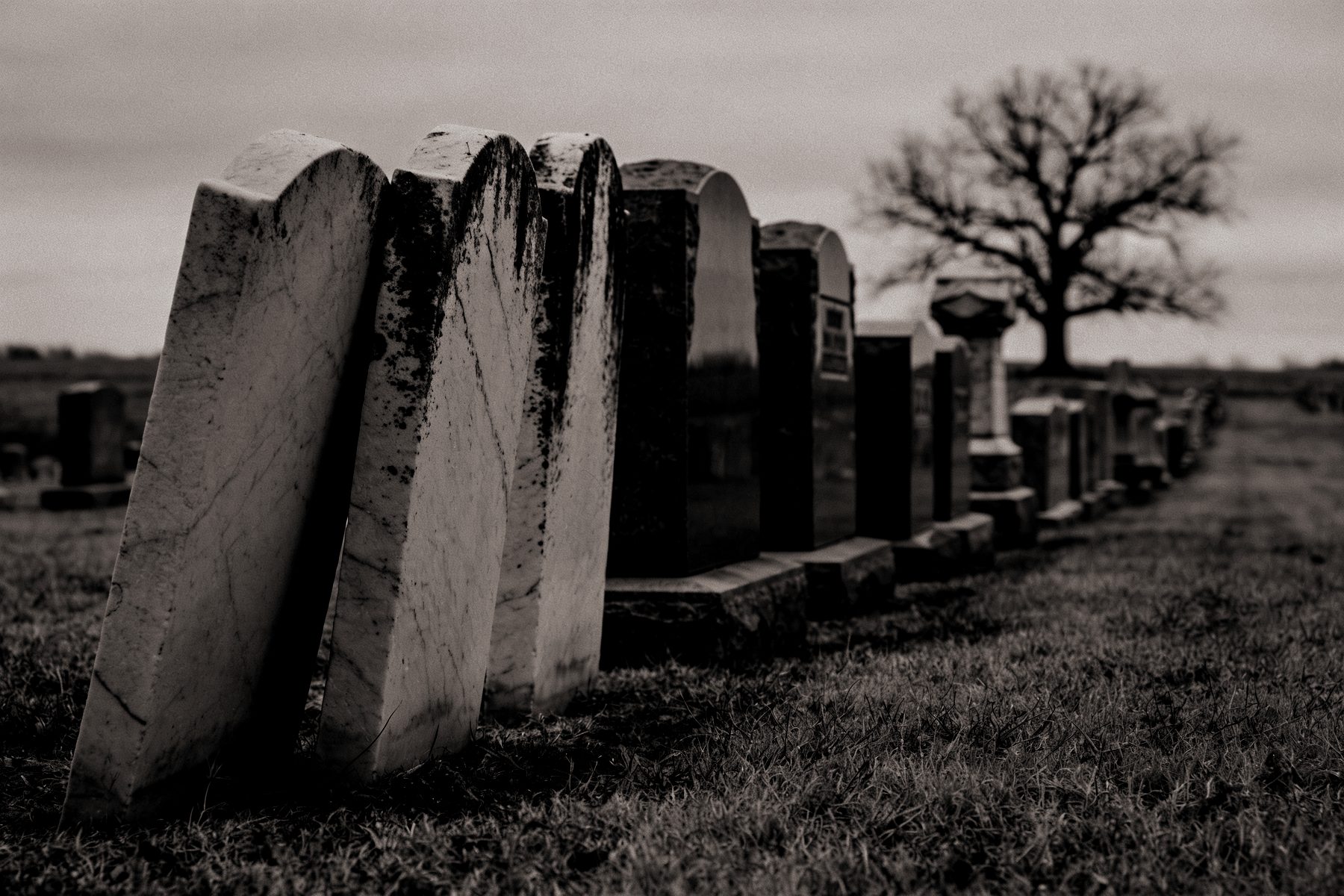
A long receding row of monuments in an old prairie cemetery, leaning weathered marble slabs at the near end and darker polished granite further along, bare oak and flat farmland behind.
Marble at the near end, granite behind it. Roughly a century separates the two, and the difference in how they have held up is visible from the road.

After it is standing

Two jobs come back, and one of them people get wrong.

The second date

It is cut at the cemetery, on the stone, standing in the grass. Nothing comes back to the shop for it. We match the letter style and the depth that is already there, tape a stencil on the face, and blast it in place. Families who left room for a second name are often surprised that it is a separate job at a separate price, so we would rather say it now than then.

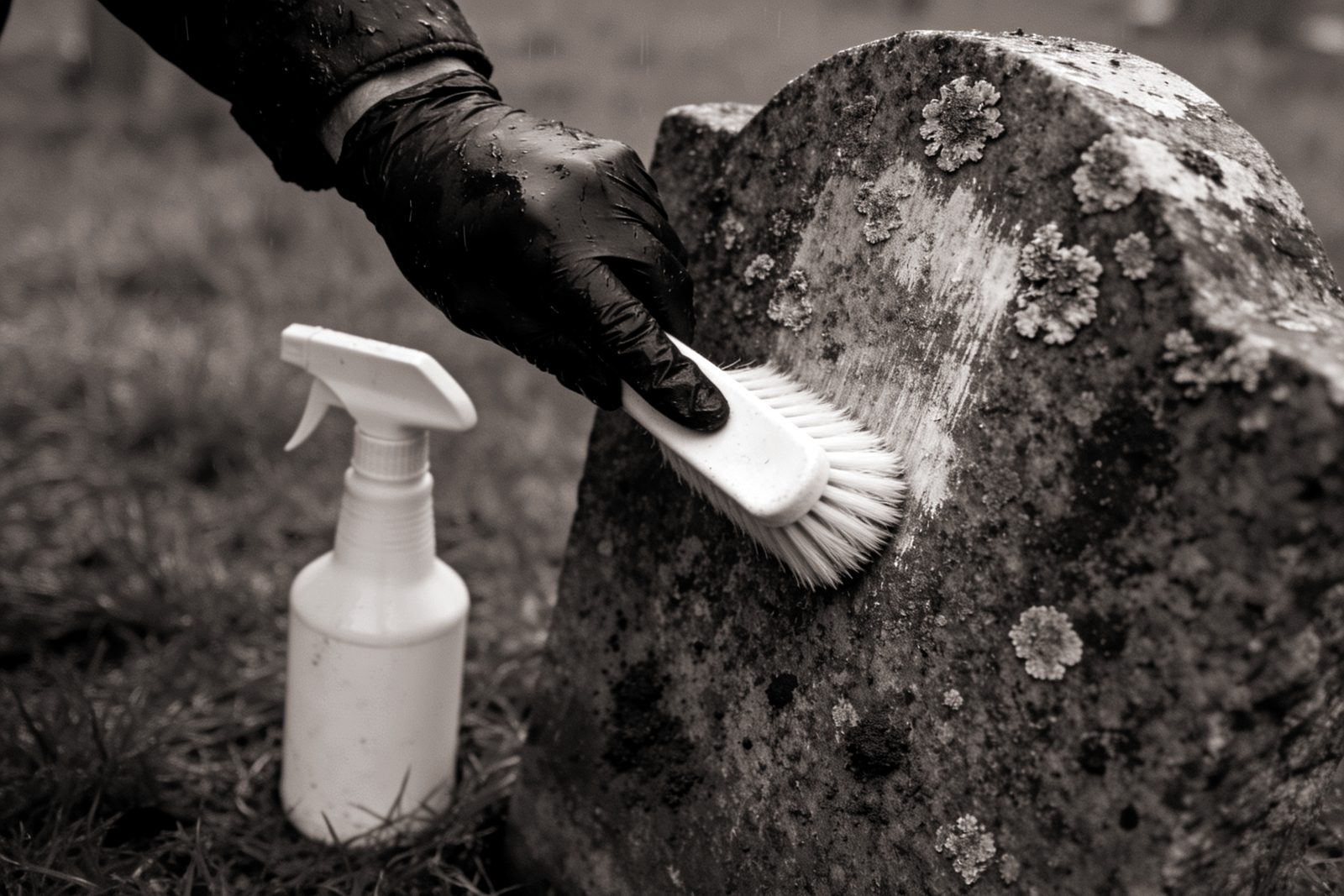
A gloved hand drawing a soft white nylon brush down the lichen-crusted face of an old granite marker, a plain spray bottle standing in the wet grass beside it, one band of the stone already visibly cleaner.

Cleaning it, without wrecking it

Never a wire brush, a metal scraper, a drill attachment or an abrasive pad. Never bleach, acid, vinegar or a household cleaner. Never a pressure washer, which will open a crack it did not make. What works is D/2 Biological Solution and a soft nylon or natural bristle brush no stiffer than a toothbrush, ten to fifteen minutes of dwell, once or twice a year. It keeps getting cleaner for two or three weeks after you have gone home. If you would rather not, tell us and we will do it.

The only portfolio in this trade that means anything

A hundred and fifty-four years of our work is standing outdoors within thirty miles of this building, in every finish and every letter style we have ever sold, and it has been weathering the whole time. No showroom sample can tell you what a frosted panel or a steeled margin actually looks like at forty years, because the sample has been indoors. The cemetery can. Tell us which one you will be in and we will tell you where to stand and what to look at.

There is no hurry on our side.

Nothing about a monument is urgent and a shop that tells you otherwise is selling you something. Come and stand in front of the stone in daylight. Bring a photograph if there is one. Bring nothing if there is not.

Call

(816) 555-0148

The shop

214 Depot Street
Cameron, Missouri 64429

Open

Monday to Friday, 8:00–4:30
Saturday, 9:00 to noon
Closed Sunday

Setting season

March to November, ground permitting